
Hair services
How to Tell Hair Stylist Exactly What You Want Without the Awkward Miscommunication

Jul
“I showed her the photo. I described exactly what I wanted. And somehow I still left with something completely different.” This is the most common client complaint in any professional salon — and it is almost never the result of a bad stylist or a deceptive client. It is the result of a communication gap that almost nobody teaches you how to close. This article is the companion guide to our flagship post The Hidden Truth About What a Great Haircut Actually Does for Your Confidence, and it addresses the single variable that determines whether you walk out of an appointment elated or defeated: the quality of the conversation before anything starts.
The Photo Problem — And How to Use Reference Images Correctly
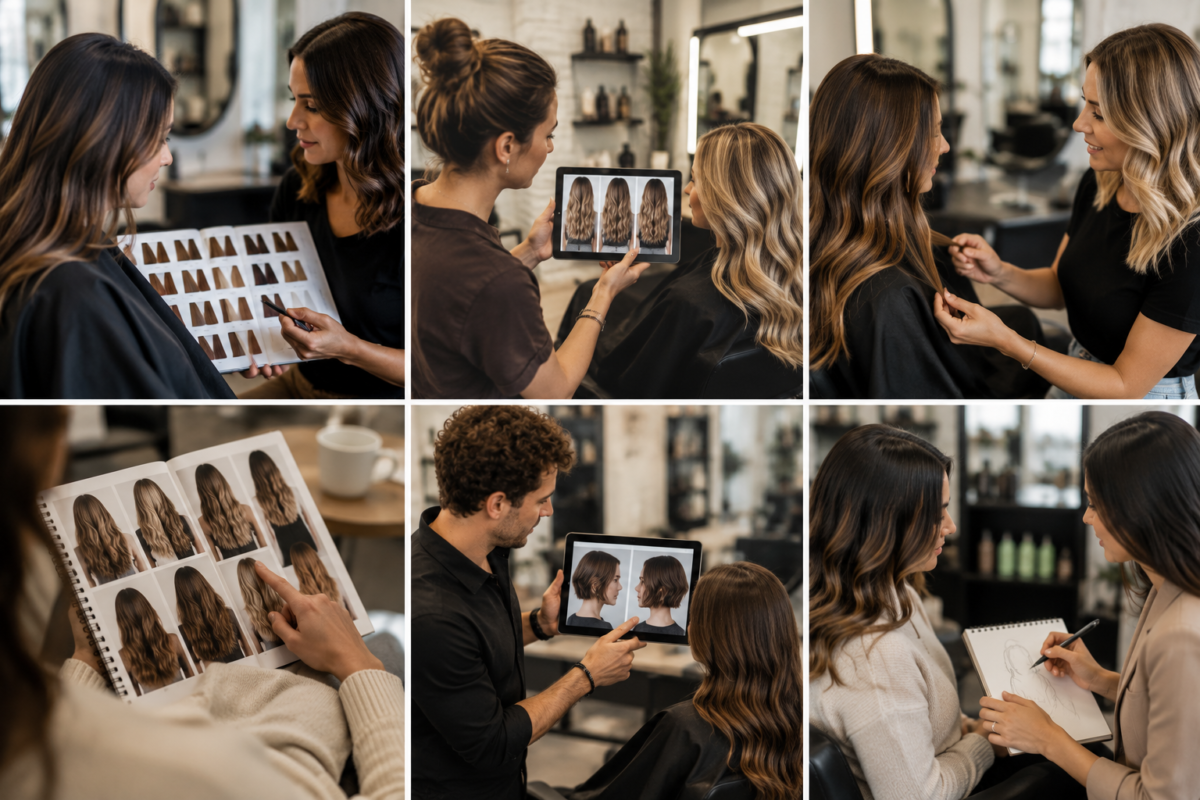
Photos are powerful tools, but only when used precisely. Showing a stylist a photo and saying ‘I want this’ creates immediate ambiguity. What specifically do you want? The length? The texture? The colour tone? The way the layers fall? The part placement? When you bring a photo, isolate the elements. ‘I love the length in this image, specifically how it hits just below the collarbone. I like how the ends are blunt, not layered. I like the colour warmth but I don’t want it this light on top.

Specificity collapses the gap. Bring three or four reference images if possible — one that shows what you want (length, cut, colour), and ideally one or two that show what you definitely do not want. The ‘don’t want’ images are often more useful to a stylist than the ‘want’ images.
The Language of Length: Stop Saying ‘A Little Off’
‘A little off’ is the phrase responsible for more post-appointment regret than any other in the salon industry. To one stylist, ‘a little’ means a quarter of an inch. To another, it means two inches. Eliminate the ambiguity entirely by anchoring your language to your body. ‘I want the length to sit at my collarbone.’ ‘I want it to just graze my shoulders.’ ‘I want it no shorter than my chin.’ Body landmarks are shared references that leave no room for interpretation.
Describe Your Lifestyle, Not Just Your Vision
How much time do you spend on your hair each morning? Do you air-dry, blow-dry, or use heat tools? Do you work in a professional environment that requires a polished look daily, or do you spend weekends outdoors and in the water? These are not trivial questions. A stylist who knows you spend three minutes on your hair in the morning will recommend a completely different cut and colour than one who assumes you have time for a full blowout. Our published article 5 Game-Changing Hair Hacks Only Fairfax Stylists Swear By shows exactly how lifestyle context shapes every expert recommendation — and why the stylists who ask those questions first consistently produce better results.
Be Honest About Your Hair History
Has your hair been chemically treated? Bleached? Relaxed? Coloured at home within the last six months? This is not small talk — it is clinical information that affects which services are safe and what results are achievable. A stylist who does not know your hair history is working blind. And unlike a doctor, they cannot run a test to find out. You are the only source of this information. Be thorough, even if it means admitting to a box dye two months ago.
The ‘Check-In’ Mid-Service: Use It
If your stylist offers to show you a progress mirror mid-haircut — take the look seriously. This is not a formality. It is your last opportunity to course-correct before more length is removed or a second round of product is applied. If your stylist does not offer a check-in and you are feeling uncertain, ask for one. A professional will welcome it.
What to Do When Something Is Going Wrong in Real Time
Clients often sense mid-appointment that something is off — but say nothing because it feels awkward to speak up while a stylist is working. That discomfort costs you hours of regret. If you are sitting in the chair and something does not look right, say so. You do not need to be aggressive or accusatory. ‘Actually, could we pause? I want to check the length before we continue’ is entirely reasonable and any professional stylist will stop without hesitation.
After the Appointment: Ask the Questions That Matter
Before you leave the chair, ask your stylist to walk you through how to recreate the look at home — which products to use, in what order, and with what tools. Ask how long the colour or cut will hold its shape before it needs refreshing. Ask what to avoid doing in the first few days after the service. These questions turn a single appointment into an ongoing result. Pair this with the information in Hair Treatment Tips: How Fairfax’s Climate Affects Your Hair to understand how your environment affects your hair between appointments — and how to protect your investment between visits.
At Alexandre de Paris, our stylists are trained specifically in consultation technique. Every appointment includes a structured conversation before any service begins. Browse our Hair Colour Services and Hair Treatments pages to see what a fully consultative hair experience looks like — and what services are available to maintain your result between appointments.
Our upcoming Tier-3 guide What Questions Should You Ask Before Getting a Haircut or Color at a New Salon? gives you a printable list of the 12 questions every new client should ask before trusting anyone with their hair — organised by the stage of the appointment at which to ask them.
Communication is the foundation of a great hair appointment. Book with Alexandre de Paris Beauty Salon & Spa in Fairfax, VA; where the consultation is not optional, it’s the first part of the service.
